Sydney Feager, a TCU sophomore from Wright City, Missouri, has competed in 10 meets in her young collegiate Horsemanship career. She earned her first MOP award this season against No. 6 Oklahoma State on October 3, earning a 77.5 for her first collegiate victory. This is her story.
When I was four years old, I rode a horse for the first time at our small-town pumpkin patch, and from that moment on, I was completely hooked. I grew up in the close-knit community of Lake St. Louis, Missouri, and had the kind of childhood where I was always outside until the streetlights came on. Not long after, I began taking horseback riding lessons, and even at such a young age, I knew horses were going to be a part of my life.
As a sophomore in high school, I attended my first college riding camp at Auburn University. I still remember sitting on the living room floor watching a movie with my dad when I saw a Facebook post announcing the camp dates. I asked him if he ever thought I could ride in college. At the time, I was only showing at the state level and at saddle clubs, often riding some pretty questionable horses. Still, after that camp, I became completely energized by the idea of being a collegiate equestrian, and I knew nothing was going to stop me from chasing that dream.
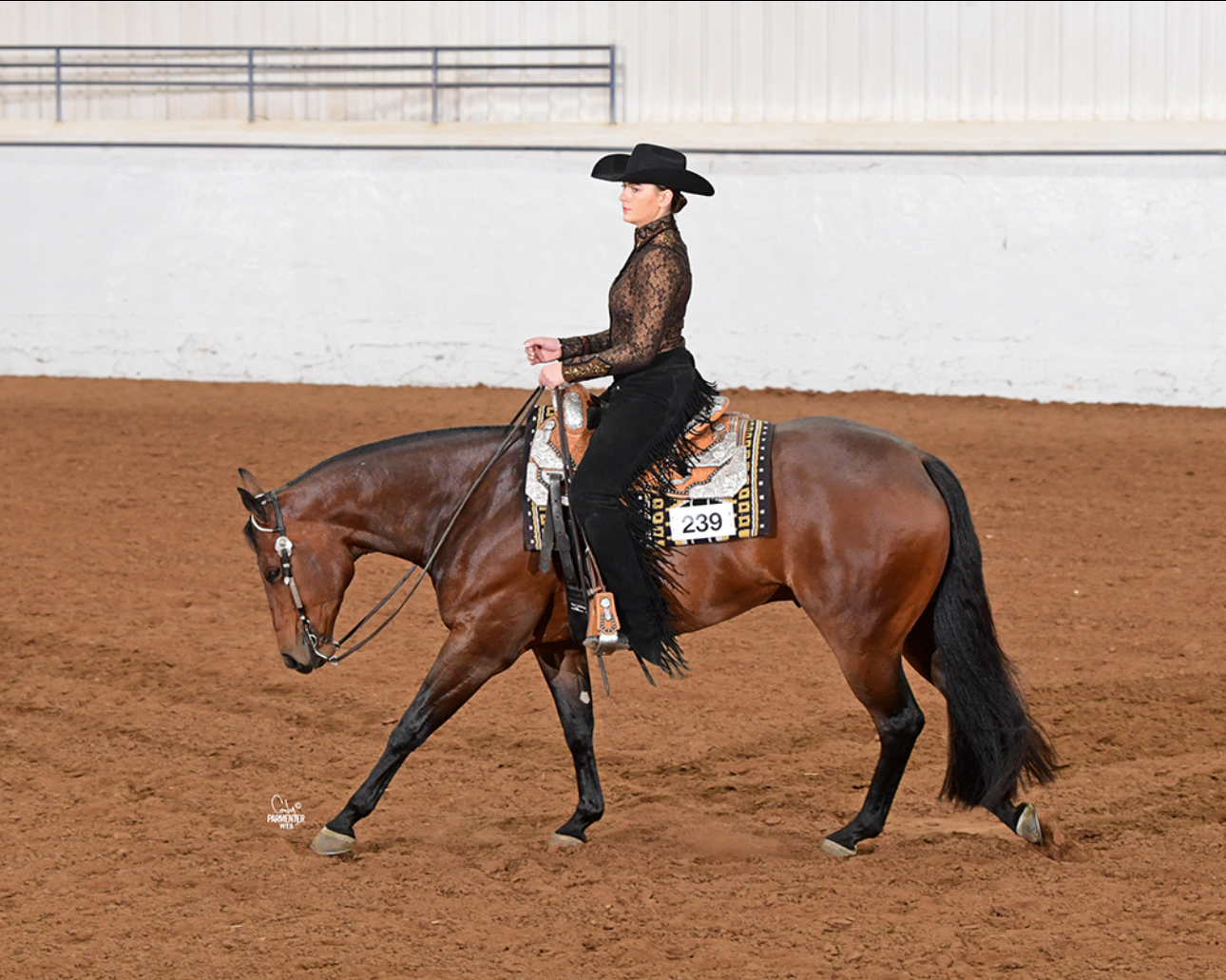
My parents dropped everything to support me, and their commitment never wavered as we moved up to the next level of competition. We sold the horse I was riding and switched trainers, which led me into the AQHA world – an entirely new and intimidating experience. I started at the very bottom of the show food chain, but that never discouraged me. I rode anything I could, whenever I could.
That hard work paid off when I qualified for the Level 1 Championships in Ohio and finished as a finalist in equitation. From there, I advanced to the Youth World Show, where we placed third in Level 1. I was beyond excited, yet even that success didn’t fully satisfy me, it only deepened my desire to keep improving and to strive for excellence.
I wanted more, and I knew the only way to get there was to put my head down and work even harder. I was the one who brought up the idea of sending our horse to Texas. I knew that’s where the best of the best were trained. After months of searching, we found Robin and Jenny Frid, and it was clear their program was the right fit for us.
At the same time, I was still grinding to find a college team to ride for. I attended several camps after Auburn, including Texas A&M and OSU, but my smaller show record and limited accolades didn’t always reflect the work I had put in. Shortly after joining the Frids, I went on an unofficial visit [at TCU] and met Coach Dukes, who saw something in me that I was still fighting to prove.
Motivated more than ever, I attended my final camp at TCU. A couple of weeks later, I committed. For the first time, it truly felt like everything I had sacrificed – the trainer changes, the horses, and the constant push to improve had finally paid off. It was incredibly rewarding, but also humbling, because I knew this wasn’t the finish line. The work wasn’t over; it was only just beginning.
I then went to the Quarter Horse Congress the winter before my freshman year with an incredible mare we leased, Good N Plenty Gold. We finished reserve champion in the 15-18 showmanship and placed 14th in the 15-18 horsemanship. Everything finally felt like it was falling into place. Just a couple of months earlier, we had also purchased our two-year-old, Yo Momma, with the goal of developing him for my upcoming Amateur years. It felt like the future I had worked so hard for was right in front of me, until the accident.

Only a few days after returning home from Congress, I was driving to work at the animal boarding and spa when I ran off the road less than a mile from my house. As I tried to correct, I oversteered and hit a culvert pipe, causing my truck to flip. It rolled several times before I was ejected through the driver’s side window. I was fully conscious when I landed, but when I tried to pull myself out of the road, I realized I couldn’t move. The first thing I did was wiggle my toes, terrified that I might be paralyzed. A good citizen who had been driving behind me pulled me out of the road, but I still couldn’t breathe or move.
By some twist of fate, I had crashed directly in front of a lavender garden in Innsbrook. People rushed out, surrounding me and praying over me. I asked one of them to call my mom, and somehow I managed to calmly recite her phone number while waiting for help. As time passed, I started turning blue and slipping in and out of consciousness. When the paramedics arrived, everything went dark.
To avoid the graphic details, I’ll simply say that the next 40 days were spent in the ICU, during which I underwent 8 surgeries. I had ruptured my aorta, collapsed both lungs, crushed my pelvis, broken my shoulder, ruptured my diaphragm, and broken nearly all of my ribs. I was placed in a medically induced coma for a week. After leaving the ICU, I spent another week in a rehabilitation hospital, followed by a week of intensive at-home therapy.
I had absolutely no idea where to go from there. My miracle-working doctors told me they didn’t understand how I survived that; medically, I shouldn’t have. I should have bled out before ever reaching the hospital, but by the grace of God watching over me, my life was spared. He saved my life.
While still in my hospital bed, just days after being extubated, I signed with TCU. We didn’t tell anyone what had happened-not even the coaches, which I definitely do not recommend. At the time, my family and doctors weren’t sure I was going to make it, so we focused on taking each day as it came and celebrating the smallest victories along the way.
After my pelvis was reconstructed and weeks passed without being able to move, I finally stood up for the first time on one leg. That moment made it painfully real that even walking again would be considered a miracle, let alone riding horses. I was devastated, defeated, and angry. Everything I had worked for felt like it had been ripped away, and suddenly, even the ability to walk normally was uncertain. I was at the lowest point of my life.
Even at my lowest, lost, broken, and unsure of who I was anymore, I somehow found a way to turn everything around. Life isn’t fair, and what happened to me wasn’t fair. But what also wasn’t fair was how I was letting the situation define me. That anger turned into fuel. I made a promise to myself that I would ride again, and that one day I would walk back into that hospital and show everyone who saved my life that I had conquered the mountain placed in front of me.
From that point on, progress became my purpose. Each day, I stood a little longer. Then I took one step farther than I was supposed to. Step by step, I kept pushing. Six months later, I walked back into that hospital not as a patient, but as proof of what determination and faith can do.
How could my lowest point also become my highest? I still don’t fully know the answer. All I knew was that I had worked too hard for everything to end there. My accident happened in October of 2023, and on January 20th, 2024, I climbed back into the saddle and rode my two-year-old for the first time since the accident. Sitting on a horse again felt like a victory in itself, one that defied every odd stacked against me.
From there, I committed to getting stronger every single day. I eventually told my coaches the full extent of what had happened, and with that honesty came clarity. My mentality returned, my drive reignited, and I realized that no matter how short the timeline or how steep the climb, quitting was never an option.
The summer before college, I moved in with my trainers and rode every horse in the barn for three straight months. I knew I had to rebuild my strength and regain my feel before starting college. Early that summer, a tornado passed directly over their house, leaving their property buried in fallen trees. What followed were long days spent cutting and clearing debris as a group. By the end of that summer, I was in the best shape of my life, physically and mentally.

That fall, I walked onto TCU’s campus and was a starter on the team the first semester as a freshman. I felt whole again. Fulfilled. Grateful in a way I never had been before.
Now, at the end of this story, I want to share one thing: you can do hard things. Hope and a dream carried me through the most difficult season of my life. I know that’s easier said than done, but I also learned something just as important: don’t rush through life. I took so much for granted, and I don’t say that lightly.
While lying in the ICU, I watched nurses and doctors walk in and out of my room, and I was envious of something as simple as their ability to walk. I remember seeing food commercials on television while I was being fed through tubes and IVs, longing for something as ordinary as eating. It’s hard to believe how much I once overlooked the little things like breathing, walking, sitting outside, and being still.
During recovery, I began questioning how often I rushed through life before the accident. I had pushed myself to exhaustion, sometimes unable to stay awake during a short drive because I had run myself into the ground. I passed up quiet moments, moments meant to be enjoyed. Now, I find myself sitting outside just watching cars pass by, not for any reason other than the beauty of the moment and the peace in the silence.
I also realized how much I had taken the big things for granted. I spent more time with my family and friends during my hospital stay than I had in years. I remember asking my mom why we ever fought over things that didn’t truly matter. I took my independence, my ability to move freely, and simply being myself for granted.
One of the most powerful lessons I learned is that no day is guaranteed. You never know when an ordinary day could become your last. When people ask me about the accident, I always tell them, “You never think it’s going to happen to you.” And it’s true. You can never fully prepare for something like that. I even went back and looked at the last messages I sent to people before the accident, knowing they could have been my final words. Some were funny, some as simple as “okay,” but now I take those moments more seriously.
I truly believe in never going to bed angry and never ending a conversation on a bad note, because you never know when that memory could be your last. If this experience taught me anything, it’s to slow down, love harder, and never take a single moment for granted.
I am beyond blessed to be where I am today, doing what I love. I always dreamed of becoming a collegiate athlete, and I now understand the depths I had to reach in order to get there. Never give up hope or your faith because being the underdog does not mean your dreams are out of reach.
I know that the little girl riding the horse at the pumpkin patch would be so incredibly proud of the person she became.